A pub name can tell you more before you reach the bar than many menus manage after you have sat down. The Red Lion, the Railway, the Old Coach House or the Jolly Farmers may sound familiar, but each points to a particular bit of British life. So, why do pubs have names? They began as practical signs for travellers and locals, then became miniature records of royalty, work, religion, transport and the people who lived nearby.
For anyone choosing a pub for a weekend pint, a historic pub crawl or a proper local lunch, the name is still a useful first clue. It will not guarantee a great pint or a warm welcome, of course, but it can hint at the building’s past and the sort of character inside.
Why do pubs have names in the first place?
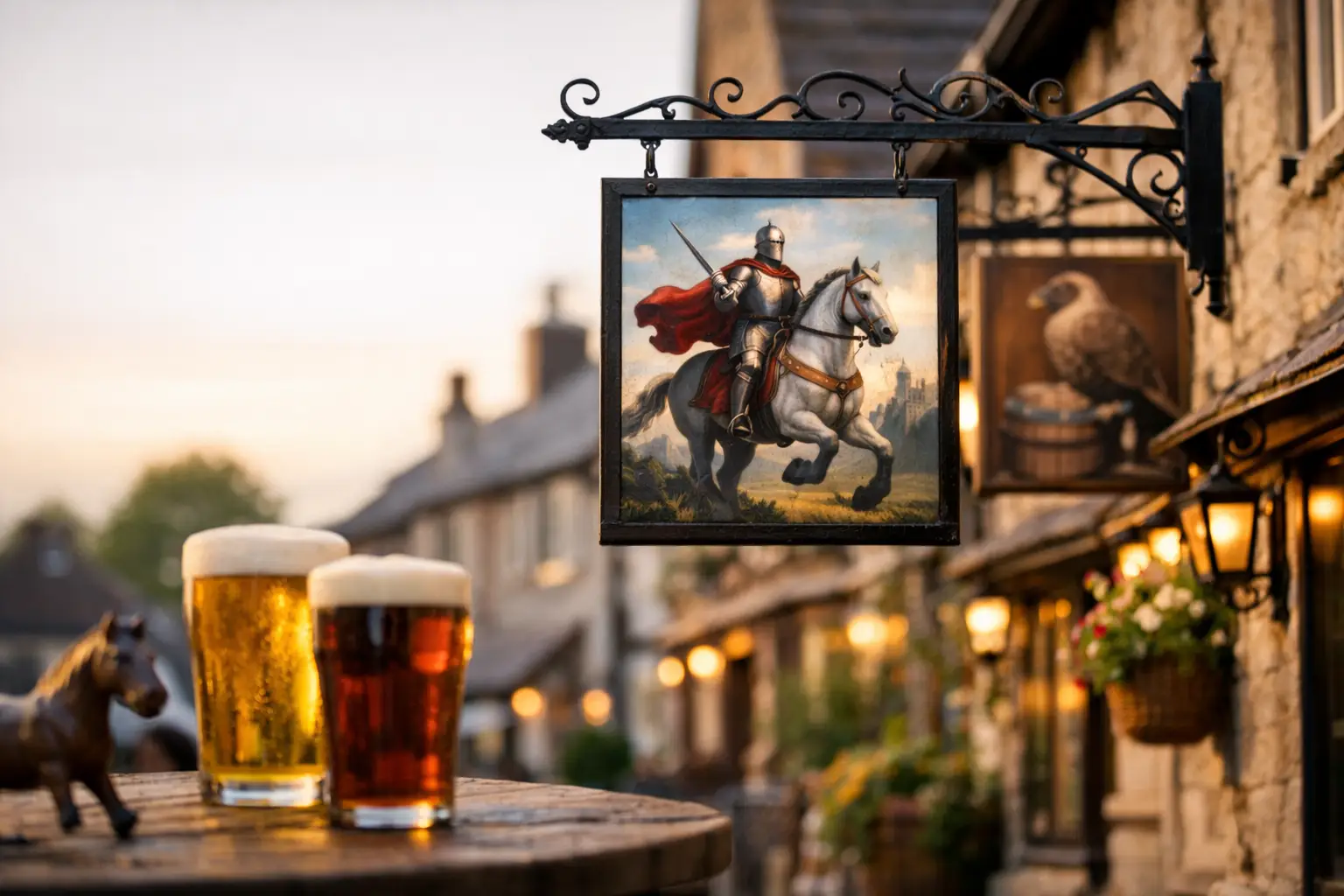
Long before house numbers, street maps and widespread literacy, a picture above a doorway was a straightforward way to identify a place. If you could not read the words, you could recognise a lion, a swan, a ship or a crown. Inn and alehouse signs helped travellers find somewhere to eat, sleep, meet a contact or change horses.
By the medieval period, public houses were woven into everyday travel and trade. A memorable sign made a venue easier to describe: meet at the White Hart, turn left at the George, stay the night at the Crown. The name and image worked together, which is why pub signs remain such a big part of the tradition. Even now, a handsome painted board can make a pub feel more rooted in its street than any modern fascia ever could.
Names also mattered commercially. A landlord needed people to remember the house, especially when many customers were passing through rather than living around the corner. A striking animal, a royal emblem or a local occupation gave the pub an identity long before branding became a boardroom word.
Royal names and national symbols
Some of Britain’s most common pub names come from monarchy and heraldry. The Red Lion is often said to be the country’s most popular pub name, and its success is no accident. Lions appeared on royal and noble coats of arms, while James VI and I is widely credited with encouraging the red lion of Scotland to be displayed after the Union of the Crowns in 1603.
The Crown, the King’s Head, the Queen’s Head, the Royal Oak and the George all draw on the same instinct: royal connections suggested loyalty, status and a recognisable image. The Royal Oak has a particularly clear story, recalling the oak tree in which Charles II supposedly hid from Parliamentary troops after the Battle of Worcester in 1651.
That does not mean every Crown has a direct royal visitor in its cellar, despite what a lively bit of pub folklore may suggest. Often, the name is symbolic rather than a documented local event. Still, these names show how national history travelled into ordinary streets, villages and market towns.
Animals were easy to spot and rich in meaning
Animals are everywhere on pub signs because they were visually simple, memorable and loaded with associations. The White Hart, a white stag, was linked with Richard II. The Greyhound could suggest speed, hunting or aristocratic sport. The Fox and Hounds nods to country pursuits, while the Swan, Black Horse and Golden Lion offered strong images that people could identify at a glance.
Colour often distinguishes one pub from another. There may be a Red Lion and a White Lion within a few miles, or a Black Swan and a White Swan in neighbouring towns. It is practical, but it also gives each house a slightly different personality.
Animal names should not be read too literally. A pub called the Dolphin may be nowhere near the sea, and a country pub called the Plough may now serve excellent small plates rather than welcome farmhands at dawn. The name is a surviving layer of history, not a fixed description of the current offer.
The road, the railway and the working day
Many pub names are grounded in the jobs and journeys that shaped a place. The Railway, Station Hotel, Coach and Horses, Wagon and Horses, Navigation and Canal Tavern all point towards movement. These houses often appeared where travellers, carriers and railway workers needed refreshment, accommodation or a place to wait.
A pub called the Plough, the Mason’s Arms, the Carpenter’s Arms, the Blacksmith’s Arms or the Miner’s Arms may reflect local trades, a historic employer or the people who regularly drank there. In former industrial areas, these names can be a useful prompt to look around: a canal basin, old works, terraced streets or a disused line may explain the sign.
There is a trade-off, though. The more common the name, the less certain its precise origin becomes. A Railway pub might genuinely have opened with the station, or it may simply have adopted a fashionable Victorian name. If a pub’s history matters to your visit, look for a date on the sign, a local history board or a note on the menu – then treat the good stories with friendly curiosity rather than unquestioning certainty.
Saints, churches and older customs
Religion has also left its mark. Names such as the Cross Keys, the Lamb and Flag, the Angel and the Three Tuns can carry Christian imagery, although their histories are often mixed with guild symbols, local customs and old brewing trade signs.
The Three Tuns is a particularly pubby example. A tun was a large brewing or wine cask, so the name could advertise the business directly. Similarly, the Hop Pole, Barley Mow and Malt Shovel speak to the ingredients, tools and labour behind beer. They are reminders that the pub was never only a drinking room. It was part of a wider network of farming, brewing, hauling and hospitality.
Some names also preserve a local legend, an old fair, a coaching stop or a long-vanished building. The Old Mill, the Castle, the Priory or the Gatehouse may sit beside the feature they describe, or may keep its memory alive after it has gone. That small mystery is part of the pleasure of finding a new local.
Why names still matter to pub-goers
A good pub name does more than decorate a sign. It gives you something to remember when arranging to meet friends and can make a route through an unfamiliar town far easier to follow. On a planned pub crawl, names help create a sense of place: perhaps a former coaching inn, a canalside ale house and a Victorian railway pub in one afternoon.
They can also help set expectations, though never perfectly. The Rose and Crown may be a low-ceilinged village local, a smart town-centre dining pub or a modern refurbishment in an old building. The name offers a starting point; honest pub reviews, recent photos and local knowledge tell you what it is like now.
This is where community recommendations are valuable. A historic-sounding sign is appealing, but it is more useful to know whether the cask ale is well kept, the garden catches the evening sun, the kitchen is worth booking or the atmosphere suits a quiet catch-up. Pub character is built by the people running and using the place, not solely by the words over the door.
A small guide to reading a pub sign
When you spot a name that catches your eye, consider three things. First, does it refer to a person, animal, trade or nearby landmark? Second, could it be tied to a national event or a local industry? Finally, does the building itself support the story – perhaps through its age, location or old-fashioned layout?
You will not always find a definitive answer, and that is fine. Pub history is full of renamed houses, rebuilt premises and tales polished over decades of conversation. The best approach is to enjoy the clue without forcing every name into a grand story.
If you like keeping a record of the places behind those signs, Pubs Near Me: Pub Finder UK lets you find pubs nearby, save favourite pubs, plan a considered pub crawl, track visits and add your own ratings. It is handy when a promising-looking White Hart or old Railway appears halfway through a day out.
The next time you pass a pub sign, give it a second look before heading in. That lion, plough, coach or crown is not just there to fill a board above the door. It is a small invitation into the history of the road, the neighbourhood and the people who have gathered there over the years.