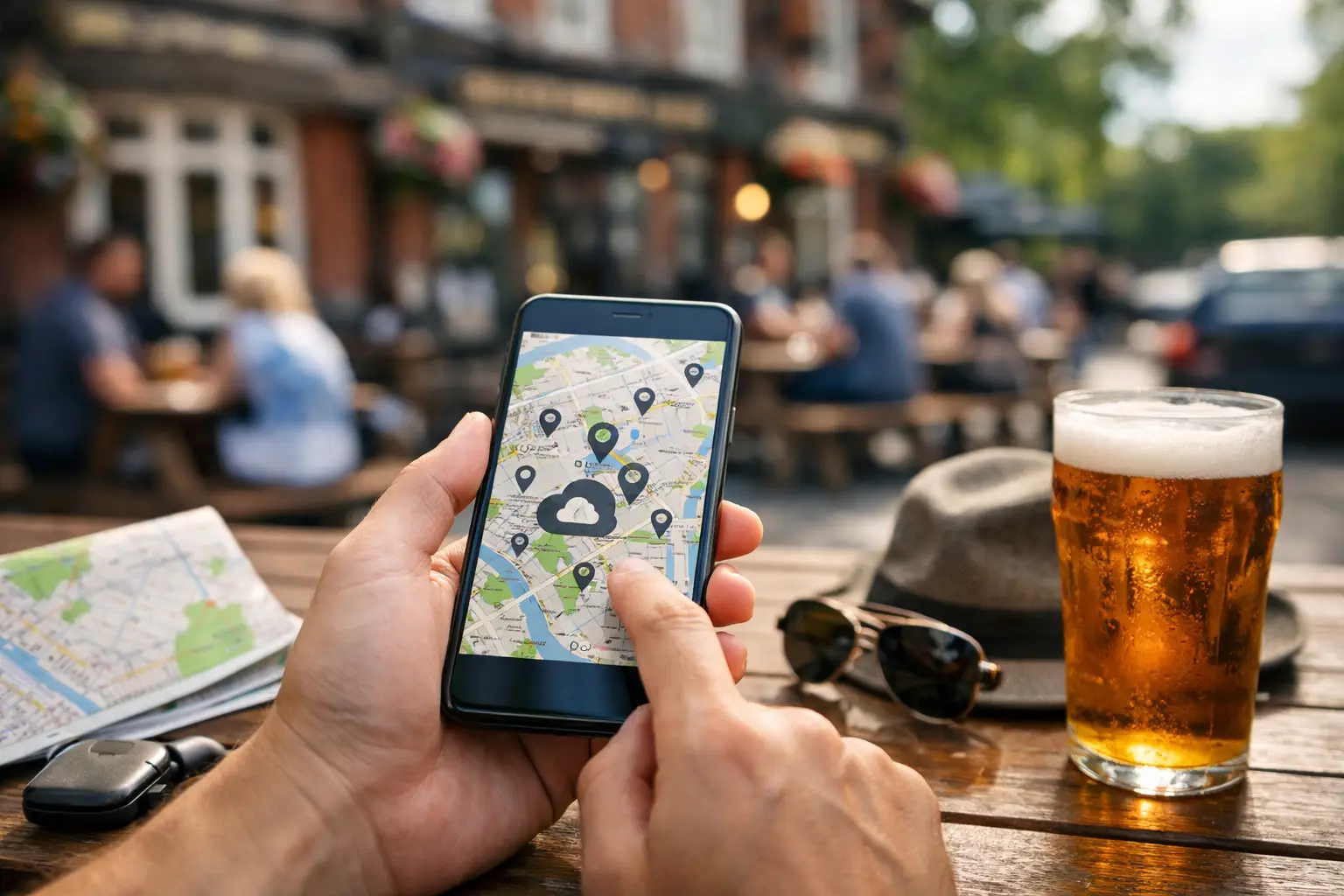
A signal disappearing halfway through a station underpass, on a country lane or in the middle of a busy city centre should not be the reason a well-planned pub day falls apart. If you want to save favourite pubs offline, a little preparation means you can still find that tucked-away ale house, remember the good Sunday roast spot and keep your route moving without hunting for Wi-Fi.
This is particularly useful for pub crawls, walking weekends and city breaks. Mobile coverage is usually fine in most places, but ‘usually’ is not much help when you are trying to check an address, opening time or the next stop on the list. An offline pub plan is less about being overly organised and more about leaving room to enjoy the day.
Why saving pubs offline is worth doing
A favourite pub list often starts simply: somewhere with a brilliant pint, a proper fire, a beer garden worth revisiting or a warm welcome after a long walk. The trouble comes when those saved places are scattered across browser bookmarks, map pins, screenshots and group-chat messages.
Keeping the essential information available offline gives you one reliable reference point. You can check a postcode when a taxi needs it, confirm which street a historic pub is on, or remember why you wanted to visit in the first place. It also helps when travelling abroad with limited data, visiting rural parts of Britain or trying to preserve battery on a long day out.
There is a useful balance to strike. Offline notes are excellent for the basics, but they are not a substitute for checking current details before you leave. Opening hours, kitchen service, events and temporary closures can change. Use your saved list as your plan, then give the key details a final look while you still have a connection.
Save favourite pubs offline with the details that matter
A pub name alone is rarely enough. Plenty of places share similar names, and a search for The Red Lion can become a surprisingly broad adventure. For each pub you save, keep the name, full address or postcode, and a short note explaining why it made the cut.
That note is the bit people often miss. Instead of writing ‘nice pub’, add something useful: ‘cask ale and quiet back room’, ‘good stop before the match’, ‘dog-friendly garden’, or ‘book ahead for Sunday lunch’. A few words make it much easier to choose the right place for the moment.
For a multi-stop route, add the order you expect to visit pubs in, plus a rough walking time between them. Do not plan every minute too tightly. The best afternoons often involve staying longer than intended because a pub has live folk music, a particularly good guest beer or a table in the sun. Think of your route as a helpful shape for the day, not a military operation.
Keep a screenshot as a simple backup
Screenshots are the quickest offline safeguard. Before setting off, capture your saved pub list, the key map area and any important booking confirmation. Make sure street names and postcodes are visible, rather than taking a zoomed-out image that becomes useless when you need directions.
It is worth creating a dedicated album on your phone called something obvious, such as ‘Manchester pub day’ or ‘Northumberland walk pubs’. That saves scrolling through months of photos when everyone is waiting outside and somebody asks where the next pint is happening.
Screenshots have limits. They cannot update, and they can become a muddle if you save too many. They work best alongside a clean note containing the essentials.
Download the map, not just the pin
If your route covers several neighbourhoods or a rural area, download an offline map of the area before leaving home or your accommodation. Choose a wide enough area to include detours, railway stations and the walk back, not only the pubs themselves.
Offline maps are particularly handy for ale trails and countryside routes, where the next pub might be a few miles away rather than around the next corner. Save enough battery for navigation, carry a charger if you can, and keep an eye on the time. A good route home matters as much as a good first stop.
Build a pub list that works in the real world
The strongest saved lists are selective. Fifteen pubs may sound like a magnificent day out, but it is not always realistic or enjoyable. Pick a few must-visits, then add one or two nearby alternatives in case a pub is full, not serving food when expected, or simply does not suit the group on the day.
For each area, choose pubs with different strengths. You might start at a traditional local for a relaxed first pint, keep a food-led pub in reserve for lunch, and finish near the station. If you are meeting friends with different tastes, make notes on cask ale, craft beer, alcohol-free options, accessible entrances, outdoor seating and whether dogs are welcome. Those practical details prevent unnecessary faff later.
A sensible offline list also includes the useful non-pub bits: the nearest station, a taxi number saved in your contacts, and a reminder of the last train if you are relying on public transport. If someone is driving, build the plan around food and soft drinks for them, and never assume parking will be easy near a popular pub.
Add a short personal rating after each visit
Saving favourites is not only for places you have yet to try. It is how you build a genuinely useful record of the pubs you would happily return to. After a visit, add a quick score and a sentence while the experience is fresh.
Be specific and fair. ‘Excellent pale ale, friendly staff, busy after 7pm’ is much more useful than ‘great’. Equally, a pub can be a good choice for one occasion and not another. A lively sports pub may be ideal on match day but less suited to a quiet catch-up. Context makes your saved list more honest and more valuable.
Use your pub finder app as the main list
A dedicated pub finder app is a better long-term home for favourites than a random collection of browser tabs. Pubs Near Me: Pub Finder UK lets you save pubs, rate and review places, track pubs visited and build pub crawls, making it easier to turn a good find into a future plan.
Use it to keep your core list organised by town, occasion or pub style. You could create one collection for cosy winter pubs, another for beer gardens, and another for places you want to try on your next city break. Before you head out, review those saved entries and keep the important address and route information available in an offline note or downloaded map as a backup.
This approach gives you the best of both worlds. Your app keeps the bigger picture tidy and helps you discover pubs near you when you are connected, while your offline copy protects the plan when your signal is not playing ball.
A quick pre-pub checklist
Before leaving, make sure you have checked current opening times, downloaded the relevant map area, saved addresses and postcodes, and captured any bookings. Charge your phone, take a power bank for a longer route, and tell the group the first meeting point rather than relying on last-minute messages.
If you are planning a crawl, agree a pace that works for everyone and include food, water and travel home in the plan. The aim is to enjoy a few good pubs and the company you are with, not to race through a checklist.
The most memorable pub days are often built around small discoveries: a quiet courtyard behind a busy high street, a well-kept handpump, a view from a village garden, or a landlord who knows exactly which local ale to suggest. Save the essentials offline, then give yourself the freedom to follow the good bits when you find them.